

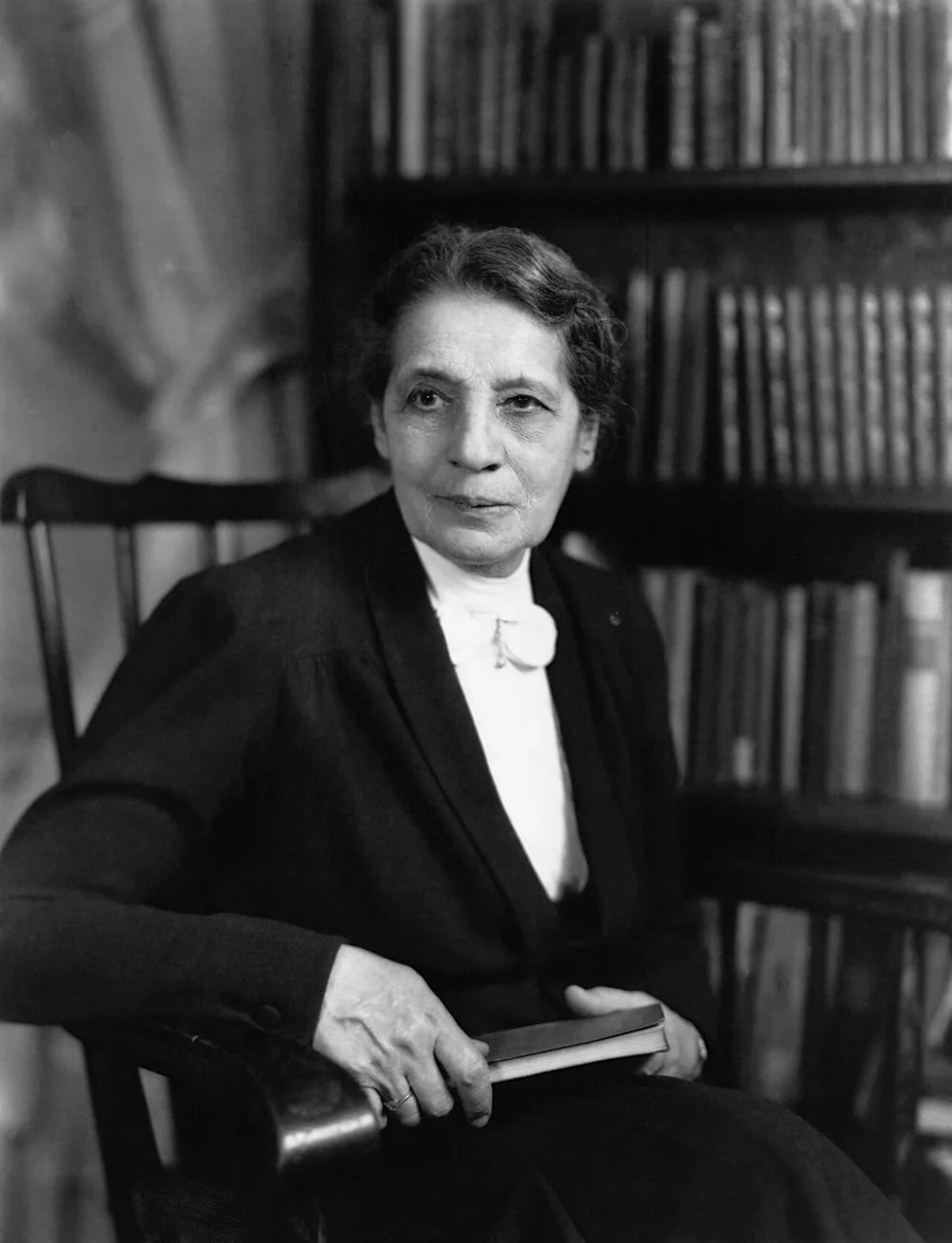
What she actually did
In December 1938 Otto Hahn wrote to Meitner from Berlin with a result he could not explain: bombarding uranium with neutrons had produced barium, an element with 40% less mass. On a walk in the snow near Kungälv in Sweden, Meitner and her nephew Otto Frisch worked out what had happened. Using Bohr's liquid-drop model of the nucleus and Einstein's mass–energy equivalence, she calculated that the uranium nucleus had split in two and that the missing mass had become roughly 200 million electronvolts of energy per atom. She had explained nuclear fission — and named it, with Frisch, after the biological term for a cell dividing.
Why you have never heard of her
The 1944 Nobel Prize in Chemistry went to Otto Hahn alone. The Swedish committee treated fission as a chemistry result and dismissed the physics that made sense of it; the physics committee was dominated by Manne Siegbahn, with whom Meitner had a poor relationship, and was biased toward experiment over theory. Hahn, under Nazi rule and later in a defeated Germany, had strong reasons to present the discovery as purely his own chemistry, and he continued to minimise her role for the rest of his life. Being a Jewish refugee who had fled Germany in 1938 did not help her claim on a German discovery.
Her life
Vienna barred girls from the schooling that led to university, so Meitner was taught privately and passed the entrance examination anyway. She received her physics doctorate in 1905, the second woman ever to earn one at the University of Vienna. In Berlin, Max Planck let her attend his lectures; she began working with the chemist Otto Hahn in a converted carpentry workshop, because women were not allowed into the main laboratory and the institute's director insisted she use a separate entrance.
The partnership lasted thirty years. She became the first woman in Germany to hold the title of professor of physics. Then the 1938 Anschluss stripped her of Austrian citizenship and, as a Jew, of protection. Colleagues organised her escape: she crossed into the Netherlands with ten marks in her purse and a diamond ring Hahn had given her in case she needed to bribe a border guard. Hahn told the institute she had gone to Vienna to visit relatives.
From exile in Stockholm — in a laboratory where Siegbahn gave her no equipment, no assistant and no real position — she received Hahn's letter. Her reply, before she had solved it, is a model of scientific temperament: "At the moment the assumption of such a thoroughgoing breakup seems very difficult to me, but in nuclear physics we have experienced so many surprises, that one cannot unconditionally say: 'It is impossible.'"
She refused to work on the atomic bomb. Invited to Los Alamos, she said simply, "I will have nothing to do with a bomb." When American newspapers later tried to make her the "mother of the bomb" who had fled with the secret in her handbag, she rejected the story entirely.
“Surely Hahn fully deserved the Nobel Prize for chemistry. There is really no doubt about it. But I believe that Frisch and I contributed something not insignificant to the clarification of the process of uranium fission.”— Lise Meitner, in a private letter
Things worth knowing
- Nominated 49 times, never awarded19 nominations for the Nobel Prize in Chemistry between 1924 and 1948, and 30 for Physics between 1937 and 1967. Her nominators included Niels Bohr, Max Planck, Max Born and James Franck — and Otto Hahn himself.
- She refused the bomb"I will have nothing to do with a bomb." She was the only leading fission physicist of her generation to decline outright.
- Element 109 is meitneriumNamed in 1997. She is the only non-mythological woman with an element named solely for her — curium honours both Marie and Pierre Curie.
- She fled with ten marksHer 1938 escape to the Netherlands was improvised by Dutch colleagues. Hahn gave her his mother's diamond ring to bribe a guard with if she had to.
- Einstein's name for herHe called her "our Marie Curie" — and rated her, in some respects, higher.
Timeline
Begins thirty years of collaboration with Otto Hahn in Berlin, working in a converted carpentry shop.
Becomes the first woman in Germany to hold a full professorship in physics.
Flees Nazi Germany for the Netherlands and then Sweden with ten marks in her purse.
Receives Hahn's letter at Kungälv and, with Otto Frisch, works out and quantifies nuclear fission.
Meitner and Frisch publish the explanation and give the process its name.
The Nobel Prize in Chemistry is awarded to Hahn alone, announced in November 1945.
Finally honoured alongside Hahn and Strassmann with the US Enrico Fermi Award.
Element 109 is named meitnerium.
What it means now
Her gravestone in Bramley, Hampshire, carries an inscription written by Otto Frisch: "Lise Meitner: a physicist who never lost her humanity." She is the clearest case in science of a prize committee getting it demonstrably wrong, and of the discipline knowing it ever since.
