

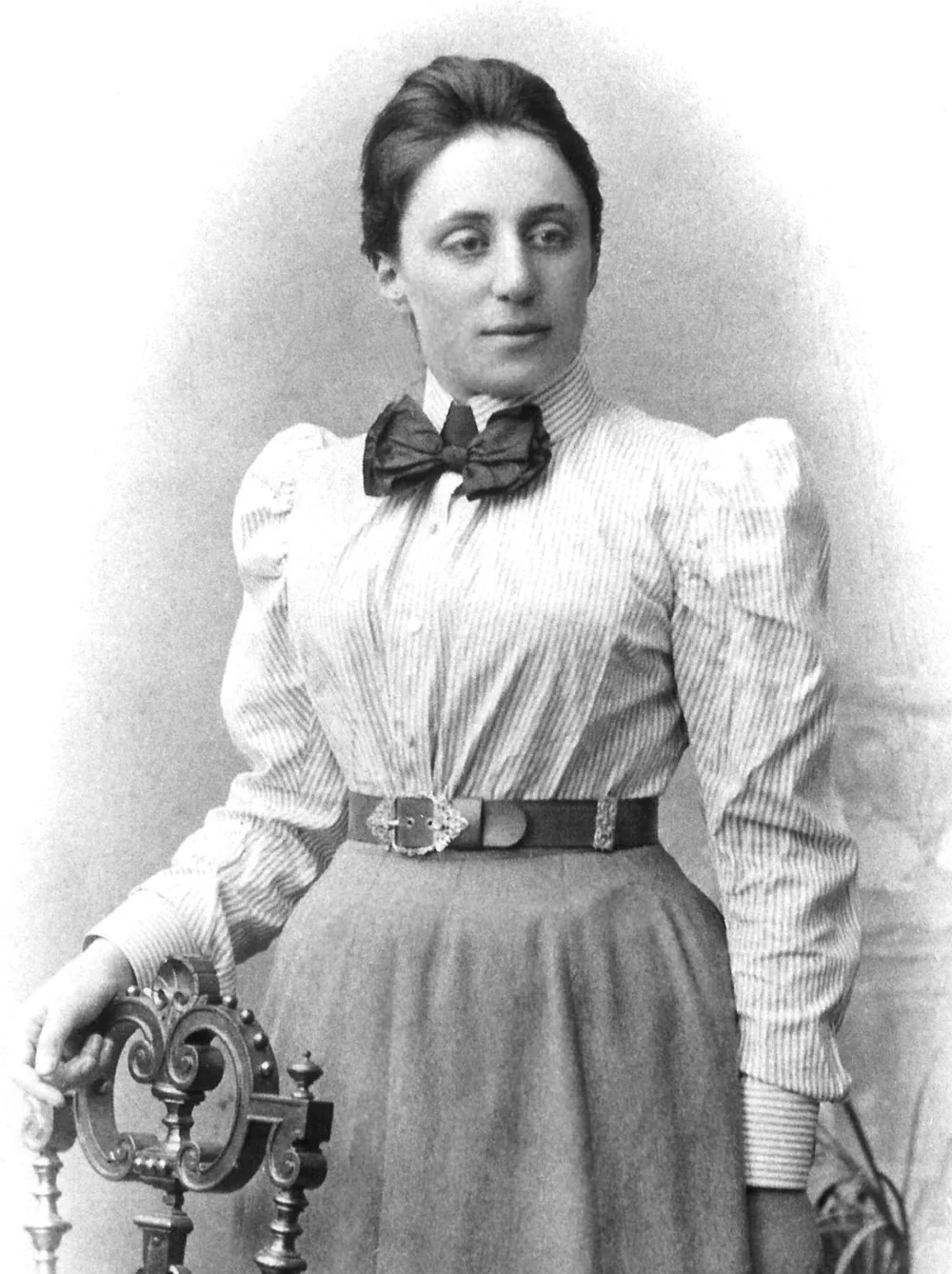
What she actually did
Noether's theorem, presented in 1918, says that every continuous symmetry of a physical system corresponds to a conserved quantity. If the laws of physics work the same tomorrow as today, energy is conserved. If they work the same here as a metre to the left, momentum is conserved. Rotate the universe and you get angular momentum. It turned conservation laws from a set of observed accidents into a consequence of symmetry, and it is the organising principle of modern particle physics and quantum field theory. Separately — and in her own view more importantly — she rebuilt abstract algebra from the ground up, inventing the structural approach to rings, fields and ideals that every algebra course now teaches.
Why you have never heard of her
Noether's erasure was administrative rather than narrative: nobody stole her results, they simply refused to pay her for them. She worked at Erlangen without salary or title for seven years. When Hilbert and Klein brought her to Göttingen in 1915, the philosophical faculty blocked her habilitation — one member protesting, "What will our soldiers think when they return to the university and find that they are required to learn at the feet of a woman?" — and for four years her courses were advertised under Hilbert's name. Her habilitation came in 1919; her first paid teaching position in 1923, at forty-one. She never held a full professorship in Germany. In 1933 the Nazis dismissed her for being Jewish, and she died two years later in American exile.
Her life
She was the daughter of the mathematician Max Noether and originally trained to teach French and English, because that was what educated German women were permitted to do. She sat in on mathematics lectures at Erlangen as one of two women among nearly a thousand students, and needed each professor's personal permission to attend.
Her 1907 doctorate, on invariants, she later dismissed as "crap". What followed was not. In three distinct phases she transformed invariant theory, then abstract algebra, then non-commutative algebra and representation theory. Her 1921 paper Idealtheorie in Ringbereichen is one of the foundational documents of twentieth-century mathematics; objects obeying the condition she used are called Noetherian in her honour, which is as close as mathematics gets to canonisation.
Noether's theorem itself came out of a specific problem: Hilbert and Klein could not make energy conservation behave properly in Einstein's new general relativity. She solved it, and in solving it produced a general principle far larger than the problem. The paper was presented to the Göttingen scientific society by Felix Klein, because she was not a member and could not present it herself.
She taught generously and chaotically, surrounded by students known as the Noether Boys, walking through Göttingen arguing mathematics at full volume. Hermann Weyl, who was given the professorship she deserved, said he was embarrassed to occupy a position she so clearly outranked him for. When the Nazis expelled her she held classes in her apartment — including, reportedly, for a student who turned up in SA uniform. She went to Bryn Mawr College in late 1933 and died eighteen months later, at fifty-three, from complications after surgery for an ovarian cyst.
“Emmy Noether — her courage, her frankness, her unconcern about her own fate, her conciliatory spirit — was in the midst of all the hatred and meanness, despair and sorrow surrounding us, a moral solace.”— Hermann Weyl, 1935
Things worth knowing
- Seven years unpaid, then four years under a man's nameAt Erlangen she worked without salary. At Göttingen her lectures were listed as Hilbert's, with a note that Fräulein Dr. Noether would assist.
- Hilbert's rebukeWhen colleagues objected to a woman habilitating, Hilbert exploded. His exact words are lost, but the version that survives is: "I do not see that the sex of the candidate is an argument against her admission. After all, we are a university, not a bathing establishment."
- Her theorem organises modern physicsLederman and Hill call it "certainly one of the most important mathematical theorems ever proved in guiding the development of modern physics, possibly on a par with the Pythagorean theorem".
- She gave her ideas awayNoether routinely handed results to students and colleagues to publish under their own names. Several famous theorems in topology and algebra are hers in substance and someone else's in print.
- An obituary in the New York TimesA letter published over Albert Einstein's name on 4 May 1935 called her "the most significant creative mathematical genius thus far produced since the higher education of women began". Historians think Hermann Weyl drafted it.
Timeline
Completes her doctorate at Erlangen, then works there for seven years without pay or title.
Invited to Göttingen by Hilbert and Klein; the faculty blocks her habilitation.
Noether's theorem is presented to the Göttingen scientific society — by Klein, because she is not a member.
Finally permitted to habilitate. Still unpaid.
Publishes Idealtheorie in Ringbereichen, remaking abstract algebra.
Delivers a plenary address at the International Congress of Mathematicians in Zürich.
Dismissed by the Nazi government; teaches in her apartment, then emigrates to Bryn Mawr.
Dies at fifty-three after surgery.
What it means now
Physicists reach for Noether's theorem the way carpenters reach for a square. It is in every quantum field theory textbook, every derivation of conservation laws, every discussion of why the Standard Model has the shape it has. Alexandrov, Einstein, Dieudonné, Weyl and Wiener all independently described her as the most important woman in the history of mathematics — which is both true and, as descriptions go, still a smaller claim than she earned.
