

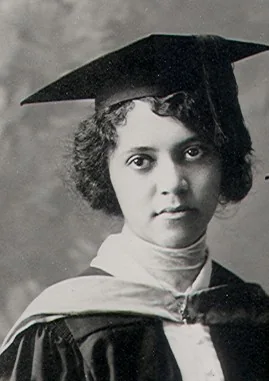
What she actually did
Chaulmoogra oil had been used against leprosy since at least the 1300s, and it barely worked — too thick and sticky to apply, too foul to swallow without vomiting, and when injected it clumped under the skin in rows of painful blisters that one observer said made the patient look as though their skin had been replaced by bubble wrap. Ball worked out how to isolate the oil's active fatty acids and convert them into ethyl esters: a form that stayed in suspension, could be injected, and was absorbed into the bloodstream. The Ball Method was the first genuinely effective treatment for Hansen's disease and remained the best available until sulfone drugs arrived in the 1940s.
Why you have never heard of her
Ball died on 31 December 1916, aged twenty-four, before she could publish. Arthur L. Dean — her graduate advisor, dean of the college and later its president — knew the process. He scaled it up, published the findings without naming her anywhere, and the technique was circulated as the Dean Method. Her name appears in none of his papers. She was restored to the record largely because Harry Hollmann, the physician who had recruited her in the first place, published a 1922 paper insisting the work was hers — and then again, decades later, by historians at the University of Hawaiʻi who went looking.
Her life
Ball came from a prominent Black family in Seattle. Her grandfather, James Presley Ball Sr., was one of the first African American daguerreotypists in the United States; her father was a newspaper editor, photographer and lawyer; her mother was a photographer too. Historians have suggested that growing up around mercury vapour and iodine-sensitised silver plates is a reasonable explanation for a chemist.
She took two bachelor's degrees at the University of Washington — pharmaceutical chemistry and pharmacy — and published in the Journal of the American Chemical Society while still an undergraduate. She chose the College of Hawaiʻi over Berkeley for her master's, and in 1915 became the first woman and the first African American to graduate with a master's degree from the institution, then its first African American research chemist and instructor.
Her thesis was on the chemistry of the kava plant. It was that work on isolating active principles from plants that brought Harry Hollmann of the Leprosy Investigation Station to her door. At the time, more than 8,000 people — mostly Native Hawaiians — were being exiled for life to the Kalaupapa peninsula on Molokaʻi. A treatment that let patients go home was not an abstraction.
She solved it in under a year, while teaching. Then she fell ill — the likeliest explanation is chlorine poisoning from a laboratory demonstration — returned to Seattle, and died. By 1920 a Hawaii physician was reporting in JAMA that 78 patients had been discharged from Kalihi Hospital after treatment with her injections.
“After a great amount of experimental work, Miss Ball solved the problem for me.”— Dr Harry T. Hollmann, 1922 — the paper that gave her back her name
Things worth knowing
- She did it in under a year, at twenty-threeWhile simultaneously teaching chemistry as an instructor at the College of Hawaiʻi.
- 78 people went homeIn 1920, four years after her death, doctors reported that patients treated with her injections were being discharged from quarantine rather than sent to Molokaʻi.
- The dean renamed it after himselfArthur Dean published the process without crediting her, and it circulated for years as the Dean Method.
- It took 84 years to get a plaqueIn 2000 the University of Hawaiʻi finally placed a bronze plaque on the campus chaulmoogra tree. The Lieutenant Governor declared 29 February "Alice Ball Day" — a date that comes around once every four years.
- Her parents were recorded as whiteBoth are listed as "White" on her birth certificate — probably an attempt to shield her from the prejudice she would face anyway.
Timeline
Graduates from the University of Washington with two degrees and a published JACS paper.
First woman and first African American to take a master's degree from the College of Hawaiʻi; becomes its first African American instructor and research chemist.
Develops the ethyl ester method for chaulmoogra oil at Hollmann's request.
Dies in Seattle, aged twenty-four, before publishing.
Arthur Dean publishes the process without her name; it becomes known as the Dean Method.
Harry Hollmann publishes a paper restoring the credit to Ball.
The University of Hawaiʻi dedicates a plaque to her; 29 February is named Alice Ball Day.
The Alice Augusta Ball Endowed Scholarship is established at the University of Hawaiʻi.
What it means now
Ball compressed into about twelve months a solution to a problem six centuries old, and she was dead before anyone outside Honolulu knew her name. Her story is the sharpest version of the pattern this project exists to document — not a slow fading, but a single act of substitution by a man who had every opportunity to type seven more letters.
