

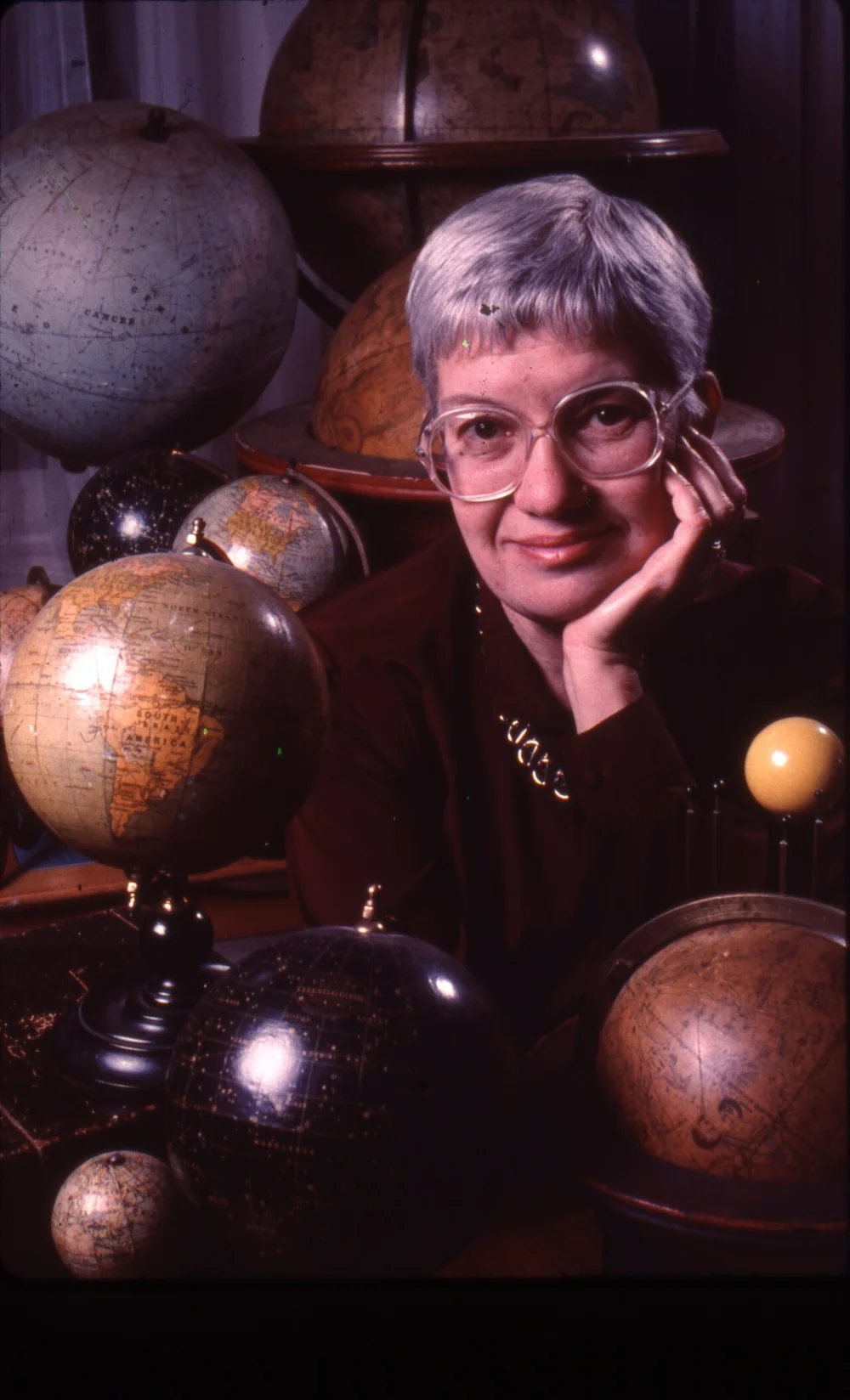
What she actually did
Rubin and the instrument-maker Kent Ford measured how fast stars orbit at different distances from the centres of spiral galaxies. The expectation, from Newtonian gravity and the visible distribution of light, was that outer stars should move slowly, like distant planets. Instead, Rubin found the rotation curves went flat: stars at the edge of a galaxy move just as fast as stars near the middle. The only way that works is if each galaxy sits inside a vast halo of matter that emits no light. Her observations, across dozens of galaxies through the 1970s, turned dark matter from a theoretical curiosity raised by Fritz Zwicky in the 1930s into a problem astronomy could not ignore.
Why you have never heard of her
Rubin was never awarded the Nobel Prize, and she died in 2016 at eighty-eight while the physics community was still arguing that she should have been. The committee has honoured observational cosmology before and since; the standard explanation — that dark matter is not yet understood, so the discovery is incomplete — sits awkwardly beside prizes given for other unexplained phenomena. Earlier in her career she had been rejected by Princeton's graduate astronomy programme, which did not accept women until 1975, and her master's thesis finding evidence of large-scale galactic motion was dismissed as nonsense before being vindicated decades later.
Her life
Rubin built her first telescope from a cardboard tube as a ten-year-old watching stars from her bedroom window in Washington, DC. She was the only astronomy major in her year at Vassar. Princeton would not send her a graduate catalogue because she was a woman, so she went to Cornell, where she took courses from Hans Bethe and Richard Feynman, and then to Georgetown for her doctorate under George Gamow.
She presented her master's work — evidence that galaxies were not simply receding uniformly but moving in bulk — to the American Astronomical Society in 1950, at twenty-two, a month after giving birth. The reception was hostile. She was right, and the phenomenon is now called large-scale streaming.
She chose galaxy rotation in the late 1960s partly, she said, because it was a backwater where nobody would bother her. In 1965 she became the first woman officially permitted to observe at Palomar Observatory, and found there was no women's lavatory. She cut a skirt shape out of paper, stuck it to the figure on a door, and said, "There you go; now you have a ladies' room."
She spent her career at the Carnegie Institution, raised four children — all four became scientists — and campaigned relentlessly for women in astronomy, routinely refusing to appear on conference panels that had no women on them.
“Fame is fleeting. My numbers mean more to me than my name. If astronomers are still using my data years from now, that's my greatest compliment.”— Vera Rubin
Things worth knowing
- The paper skirtPalomar had no women's bathroom in 1965. Rubin made one by sticking a paper skirt onto the figure on a door. It is possibly the most efficient act of institutional reform on record.
- Every rotation curve was flatShe expected a few anomalies. Instead, galaxy after galaxy showed the same thing. By the end there were around sixty, and the case was unarguable.
- All four of her children became scientistsTwo astronomers, a geologist and a mathematician. Her husband was a mathematical physicist.
- She refused all-male panelsRubin consistently turned down invitations to conferences and committees that did not include women, and said why.
- An observatory carries her nameThe Vera C. Rubin Observatory in Chile — the first US national observatory named for a woman — is now surveying the entire southern sky every few nights, largely to map dark matter.
Timeline
Graduates from Vassar as the only astronomy major in her class; Princeton will not admit her.
Presents evidence of large-scale galactic motion to the AAS at twenty-two; is dismissed.
Joins the Carnegie Institution and becomes the first woman officially allowed to observe at Palomar.
Publishes the Andromeda rotation curve with Kent Ford — the first flat curve.
The Rubin–Ford effect is published; later confirmed as large-scale streaming.
Publishes rotation curves for 21 galaxies; the dark matter case becomes mainstream.
Receives the National Medal of Science.
The Large Synoptic Survey Telescope is renamed the Vera C. Rubin Observatory.
What it means now
About 85% of the matter in the universe is dark, and we know that largely because of what Rubin measured. The observatory in Chile that bears her name will produce the largest map of the universe ever made. Her data are still in use, which is exactly the compliment she said she wanted.
