

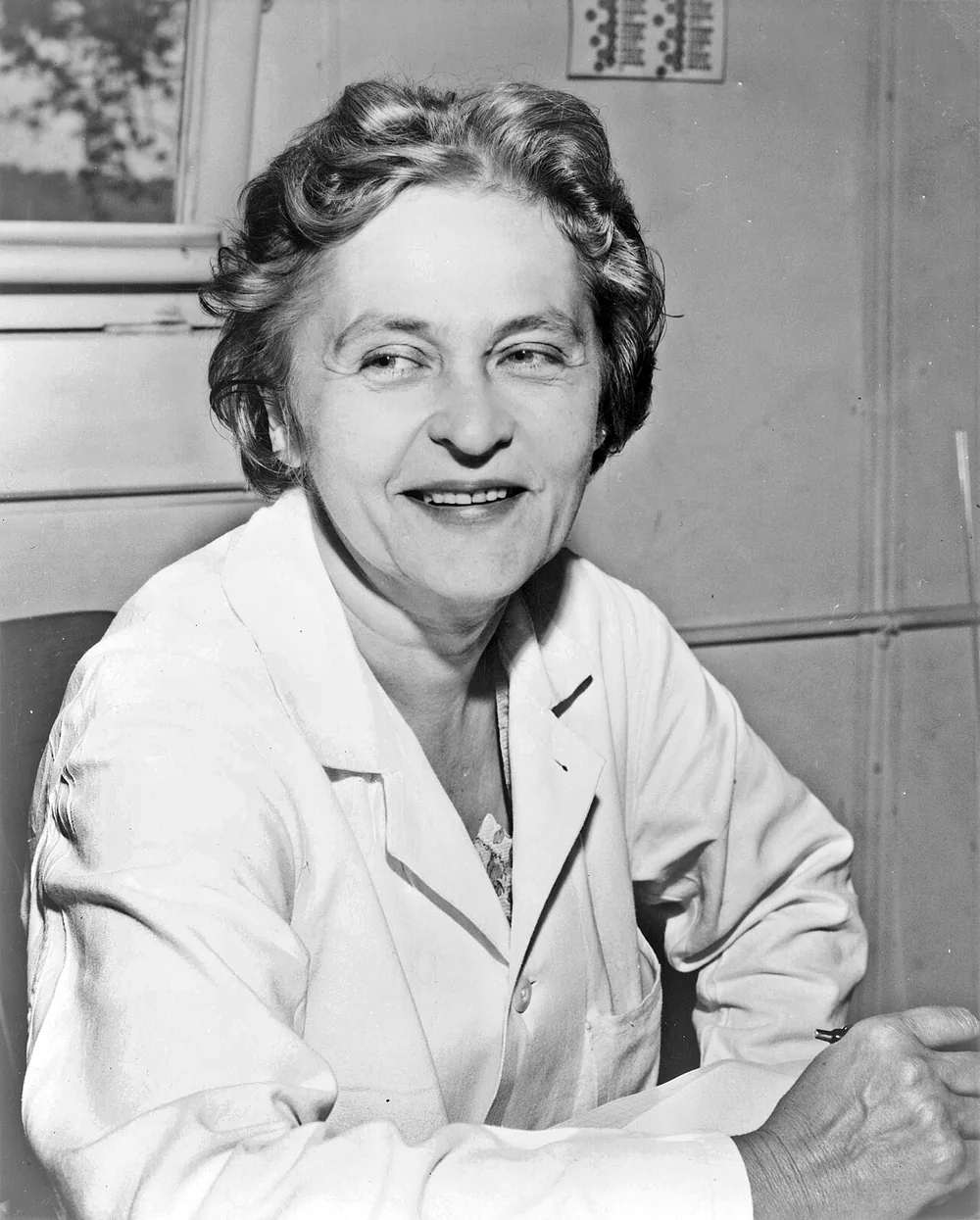
What she actually did
Telkes's central insight was that solar power's real problem is not collection but storage: the sun does not shine at night, and a solar house that cannot hold heat is a greenhouse. She worked on phase-change materials — substances that absorb and release large amounts of energy when they melt and freeze — and built heating systems around Glauber's salt, sodium sulfate decahydrate. In 1948 she and the architect Eleanor Raymond completed the Dover Sun House in Massachusetts: the first home in the world heated entirely by solar energy through a New England winter, with no conventional backup. She also invented a solar still that turned seawater into drinking water, and a solar oven designed to work at any latitude.
Why you have never heard of her
Her boss at MIT, Hoyt Hottel, chaired the solar energy fund and was sceptical of solar power in general and of Telkes's phase-change approach in particular. When an experimental house using Glauber's salt had problems in 1946, he blamed her. Despite support from MIT's president, Telkes was reassigned out of solar research and into metallurgy. Hottel had also repeatedly renegotiated the manufacturing contracts for her wartime solar still, delaying deployment until the war was nearly over. The Dover Sun House was built with private money from a patron, Amelia Peabody, precisely because MIT would not back it.
Her life
Telkes took a doctorate in physical chemistry in Budapest in 1924 and emigrated to the United States the following year. Her early career was eclectic and serious: biophysics at the Cleveland Clinic studying the energy of living cells, then research engineering at Westinghouse, then MIT's Solar Energy Conversion Project from 1939.
During the Second World War the government pulled her into the Office of Scientific Research and Development, where she designed a solar distiller small and light enough to sit in a life raft. It used sunlight to evaporate seawater and condense fresh water, and it saved the lives of downed airmen and torpedoed sailors in the Pacific. She received a Certificate of Merit for it, and in 1952 the Society of Women Engineers gave her their very first Achievement Award for the same invention.
The Dover Sun House is her monument. A wedge-shaped building with a bank of solar collectors on the south wall, it stored heat in drums of Glauber's salt tucked into the walls, and it got the Némethy family through the winter of 1948–49 on sunlight alone. It made national news. It also eventually failed — the salt separated after repeated melt-freeze cycles, a problem the field would not fully solve for decades.
She kept going for another forty years: solar ovens for use in villages, solar dryers, thermoelectric generators, materials for spacecraft. She consulted on the US Department of Energy's first solar-heated office building. She died in 1995 at ninety-four, on her first visit back to Budapest in decades.
“Sunlight will be used as a source of energy sooner or later anyway. Why wait?”— Mária Telkes
Things worth knowing
- The first house heated only by the sunDover Sun House, 1948 — designed by Telkes with architect Eleanor Raymond and funded by sculptor Amelia Peabody. Three women built the thing.
- Her solar still saved lives in the PacificA lightweight distiller for life rafts, developed under wartime research contracts, turning seawater into drinking water with nothing but sunlight.
- First-ever SWE Achievement AwardThe Society of Women Engineers gave her their inaugural award in 1952, specifically for the solar still.
- She held about twenty patentsAcross solar heating, thermoelectric generation, phase-change storage and solar cooking.
- Her approach came backPhase-change thermal storage, dismissed at MIT in the 1940s, is now standard in building-integrated energy systems and in spacecraft thermal control.
Timeline
Earns a PhD in physical chemistry from the University of Budapest.
Joins MIT's Solar Energy Conversion Project.
Develops the solar still for life rafts under the Office of Scientific Research and Development.
Blamed for problems with Glauber's salt in an experimental house and reassigned to metallurgy.
Dover Sun House is completed and heats a family through a New England winter on sunlight alone.
Receives the first Society of Women Engineers Achievement Award.
Designs a solar oven intended to be usable by children at any latitude.
Inducted into the National Inventors Hall of Fame, seventeen years after her death.
What it means now
Every solar thermal system with a storage tank is arguing Telkes's side of a dispute she lost at MIT in 1946. The nickname her colleagues gave her — the Sun Queen — was not entirely affectionate at the time. It reads differently now.
