

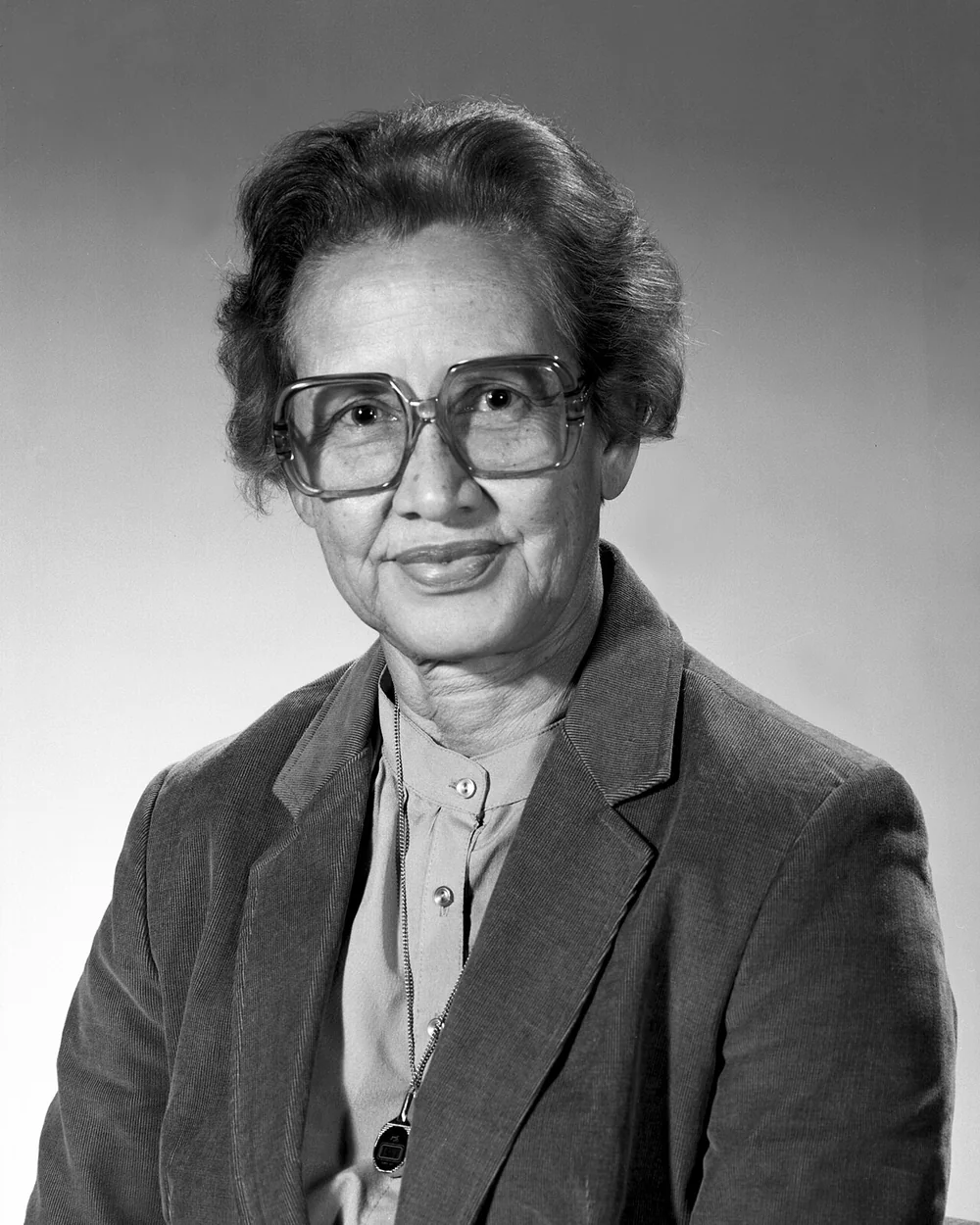
What she actually did
Johnson computed trajectories, launch windows and emergency return paths for America's first crewed spaceflights. She calculated the trajectory for Alan Shepard's 1961 flight, the first American in space. She co-authored a 1960 report deriving the equations for placing a spacecraft in a specified orbital position — the first time a woman in her division received author credit. And in 1962, when NASA first used electronic computers to generate John Glenn's orbital numbers, Glenn refused to fly until Johnson had run the same equations by hand and confirmed them. She later worked on the Apollo Lunar Module rendezvous calculations, the Space Shuttle programme, and plans for a mission to Mars.
Why you have never heard of her
Johnson worked in a segregated unit — the West Area Computers at Langley, Black women mathematicians who used separate bathrooms and a separate dining table. The work of the computing pool was by convention uncredited; the engineers whose reports the computers made possible put their own names on them. Johnson got into the editorial meetings by simply asking, repeatedly, whether there was a rule against her being there. For most of her life the general public had no idea that the arithmetic behind Project Mercury had been done in that room, by those women.
Her life
She counted everything as a child — steps to the road, dishes, stars. Her county offered no schooling for Black children past the eighth grade, so her father moved the family 120 miles so she could attend high school in Institute, West Virginia. She started high school at ten and West Virginia State College at fifteen.
The mathematician W. W. Schieffelin Claytor, the third African American to earn a mathematics PhD in the United States, added new geometry courses specifically for her. She graduated summa cum laude at eighteen. In 1939 she was one of three Black students — and the only woman — chosen to integrate West Virginia University's graduate school.
She joined NACA's segregated West Area Computing unit at Langley in 1953, and was quickly assigned to the all-male flight research team. "The women did what they were told to do," she said. "They didn't ask questions or take the task any further. I asked questions; I wanted to know why." She asked to attend the editorial briefings and was told women did not go. She asked if there was a law against it. She went.
She stayed at NASA until 1986, co-authoring twenty-six technical papers. In 2015, at ninety-seven, she received the Presidential Medal of Freedom. The following year Hidden Figures made her famous at ninety-eight. She died in 2020, aged 101.
“The women did what they were told to do. They didn't ask questions or take the task any further. I asked questions; I wanted to know why.”— Katherine Johnson
Things worth knowing
- "Get the girl to do it"Before Friendship 7, Glenn asked specifically for Johnson to verify the computer's numbers — and said that if she said they were good, he was ready to go.
- She asked why there was a ruleBarred from engineering editorial meetings because she was a woman, Johnson asked whether there was actually a law against it. There wasn't, so she attended.
- First author credit in her divisionHer 1960 report with Ted Skopinski was the first from the Flight Research Division to carry a woman's name as author.
- College at fifteen, degree at eighteenHer father relocated the family 120 miles so she could attend a high school that admitted Black students at all.
- Honoured at 97, famous at 98Presidential Medal of Freedom in 2015, Hidden Figures in 2016, Congressional Gold Medal in 2019. She lived to 101 and saw all of it.
Timeline
Graduates summa cum laude from West Virginia State College at eighteen.
One of three Black students selected to integrate West Virginia University's graduate programme.
Joins NACA's segregated West Area Computing unit at Langley.
Co-authors the report on orbital positioning — the first paper from her division credited to a woman.
Calculates the trajectory and launch window for Alan Shepard's Mercury flight.
Hand-verifies the orbital calculations for John Glenn's Friendship 7 mission at his request.
Works on the Apollo Lunar Module and command module rendezvous calculations.
Receives the Presidential Medal of Freedom at ninety-seven.
What it means now
NASA named a computational research facility in West Virginia after her in 2019 and a Langley building in 2017. Margot Lee Shetterly, whose book became Hidden Figures, put the broader point simply: in a period when computing was women's work and engineering was men's, "it really does have to do with us over the course of time sort of not valuing that work that was done by women, however necessary."
