

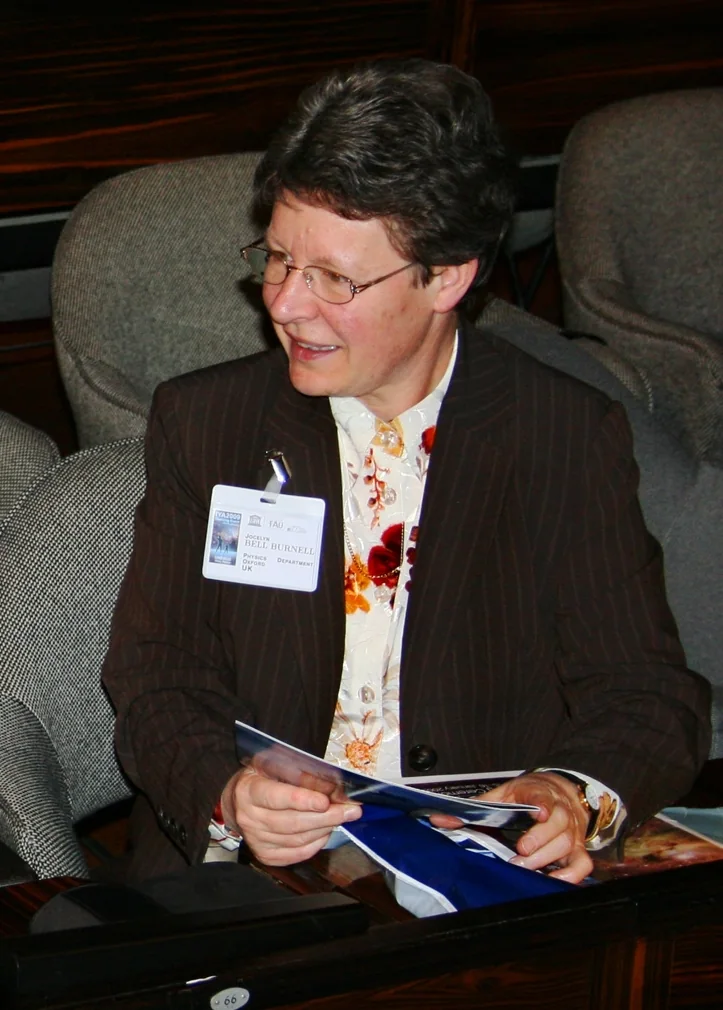
What she actually did
As a graduate student Bell Burnell spent two years helping to build the Interplanetary Scintillation Array — 2,048 dipole antennas strung across four acres of Cambridgeshire — and then analysed its output, up to 96 feet of chart paper a night, by hand. On 28 November 1967 she pinned down a quarter-inch of anomalous signal she had first noticed in August: a radio source pulsing with impossible regularity, every 1.337 seconds. It was the first known pulsar, a rapidly rotating neutron star. Pulsars confirmed that neutron stars exist, became precision clocks for testing general relativity, and gave astronomy a tool it still uses to detect gravitational waves.
Why you have never heard of her
The 1974 Nobel Prize in Physics went to Antony Hewish, her supervisor, and Martin Ryle. Bell Burnell, who had built much of the array, found the signal, and insisted on it against Hewish's initial scepticism that it was man-made interference, was not included. She was second author on the discovery paper. Fred Hoyle publicly objected to the omission at the time. Her own account of how the press handled it is bleak: Hewish was asked about astrophysics, and she was the human interest — asked her vital statistics, how many boyfriends she had, what colour her hair was, and to undo some buttons for the photographs.
Her life
Her father was the architect of the Armagh Planetarium, and the staff there encouraged her. At her school in Lurgan, girls were sent to the domestic science room while boys went to the science laboratory; her parents and others protested, and she and two other girls were allowed into science. She came top of the class.
She failed the eleven-plus. She has been notably open about it, and about impostor syndrome — she said she got through her Cambridge PhD partly by deciding that she would work as hard as she could until they threw her out, so that when they did she would know she had not wasted the chance.
She built the array with sledgehammers and wire, then read its output. The signal she spotted was so regular that the team briefly labelled the source LGM-1, for Little Green Men, before a second pulsar in a different part of the sky made an alien explanation implausible.
She has since been president of the Royal Astronomical Society, the first woman president of the Institute of Physics, and the first woman president of the Royal Society of Edinburgh. In 2018 she received the Special Breakthrough Prize in Fundamental Physics, worth £2.3 million, and immediately gave all of it to the Institute of Physics to fund doctoral studentships for women, under-represented ethnic minorities and refugee students.
“I believe it would demean Nobel Prizes if they were awarded to research students, except in very exceptional cases. The fact that I was a graduate student and a woman, together, demoted my standing.”— Jocelyn Bell Burnell, in 1977 and again in later years
Things worth knowing
- A quarter-inch of scruffThe anomaly occupied about a quarter of an inch out of a nightly 96 feet of chart paper. She noticed it because she had seen it before, in August, and remembered.
- LGM-1Little Green Men 1. The pulses were so precise that an artificial origin had to be ruled out before publication.
- She gave away £2.3 millionThe entire 2018 Breakthrough Prize went to an Institute of Physics fund for women, minority and refugee physics students.
- She failed the eleven-plusAnd says so publicly, often, to students who think a single exam has decided their future.
- Her own verdict on the Nobel"The fact that I was a graduate student and a woman, together, demoted my standing in terms of receiving a Nobel prize."
Timeline
Begins a PhD at Cambridge and spends two years building the Interplanetary Scintillation Array.
First notices an unexplained signal in the chart recordings.
Confirms the source is pulsing every 1.337 seconds — the first pulsar.
The discovery paper appears in Nature with Hewish as first author and Bell second.
The Nobel Prize in Physics goes to Hewish and Ryle. Fred Hoyle objects publicly.
Becomes the first woman president of the Institute of Physics.
Receives the Special Breakthrough Prize and donates all £2.3 million to student funding.
Awarded the Copley Medal, the Royal Society's oldest and most prestigious prize.
What it means now
Pulsar timing arrays are now one of the main ways astronomers hunt for gravitational waves from supermassive black holes. Bell Burnell is also, uniquely in this collection, someone who was present for her own rehabilitation — and chose to spend the money on making the next generation's path shorter than hers.
