

What she actually did
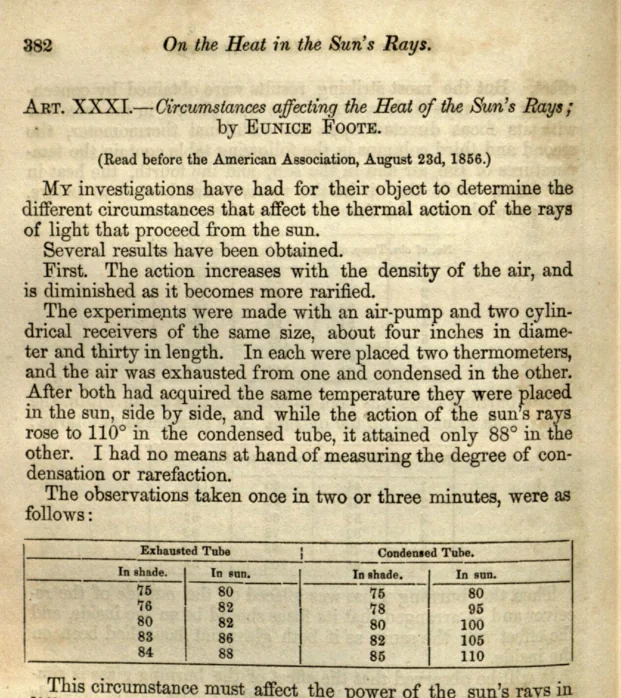
Foote took two glass cylinders, two thermometers each, and filled them with different gases — ordinary air, damp air, dry air, hydrogen, oxygen, and carbon dioxide — then set them in the sun and timed how hot each got. Carbon dioxide got hottest and cooled slowest. From that she made the leap that matters: "An atmosphere of that gas would give to our earth a high temperature; and if as some suppose, at one period of its history the air had mixed with it a larger proportion than at present, an increased temperature from its own action as well as from increased weight must have necessarily resulted." That is the greenhouse effect, written down in 1856, three years before John Tyndall's celebrated experiments and five years before he connected gases to climate.
Why you have never heard of her
Foote was not an AAAS member, and she did not read her own paper at the 1856 meeting in Albany — Joseph Henry of the Smithsonian read it for her. The AAAS then declined to print it in its annual proceedings. European journals that summarised her work cut out her climate conclusion entirely; the Edinburgh New Philosophical Journal went further and printed her husband Elisha's title over her paper. Tyndall, working with far better instruments in London, appears never to have heard of her. She vanished so completely that her rediscovery in 2011 came from a retired petroleum geologist leafing through an old annual of scientific discovery.
Her life
Foote was a scientist in a house she built for the purpose — she designed and fitted out her own laboratory in Seneca Falls, New York — and a political organiser in a town that was about to become famous. She attended the 1848 Seneca Falls Convention, the first women's rights convention in the United States, signed its Declaration of Sentiments, and sat on the five-woman editorial committee that prepared the proceedings for publication alongside Elizabeth Cady Stanton.
Eight years later she ran her sunlight experiments. Her apparatus was simple almost to the point of crudeness — an air pump, two four-inch cylinders, four thermometers — and because of that simplicity she was measuring something subtly different from the true greenhouse mechanism, which involves infrared radiation she had no way to detect. But her conclusion about carbon dioxide and the temperature of the earth was correct, and it was first.
Her paper was the first known physics publication in a scientific journal by an American woman, outside astronomy. She published a second the following year, on static electricity in atmospheric gases — again read by Joseph Henry, again at an AAAS meeting she attended but did not address. Those two papers were the only physics papers published by American women until 1889.
Scientific American did notice. In September 1856 it ran a piece headed "Scientific Ladies" which, after the condescension of the headline, said something true: that she was "deeply acquainted with almost every branch of physical science", and that where others had theorised, "this we are happy to say has been done by a lady." Then she disappeared for 155 years.
“An atmosphere of that gas would give to our earth a high temperature… an increased temperature from its own action as well as from increased weight must have necessarily resulted.”— Eunice Newton Foote, 1856 — the first published prediction of greenhouse warming
Things worth knowing
- Her own paper was read by a manJoseph Henry introduced it generously — "Science was of no country and of no sex" — then told the New-York Daily Tribune that there were difficulties in interpreting what her experiments meant.
- She signed the Declaration of SentimentsFoote was a neighbour and friend of Elizabeth Cady Stanton. The woman who first described global warming was also in the room where American feminism was founded.
- Editors deleted the climate partBoth the Edinburgh and Giessen summaries of her paper reproduced her measurements and cut her conclusion about carbon dioxide changing the climate.
- She was also an inventorFoote held patents, including one for a paper-making machine and one for a rubber-soled shoe filler. Her husband was a patent attorney; she was a patent holder.
- Rediscovered in 2011Retired geologist Raymond Sorenson found her paper while reading an 1857 volume of The Annual of Scientific Discovery. In 2022 the American Geophysical Union created a medal in her name.
Timeline
Signs the Declaration of Sentiments at Seneca Falls and edits the convention proceedings.
"Circumstances Affecting the Heat of the Sun's Rays" is read on her behalf at the AAAS meeting in Albany.
The full paper appears in the American Journal of Science and Arts — printed directly after her husband's.
A second paper, on atmospheric static electricity, is again read for her at the AAAS.
John Tyndall publishes his infrared absorption results in London, apparently unaware of her work.
Raymond Sorenson rediscovers her paper and publishes a note on it.
The American Geophysical Union establishes the Eunice Newton Foote Medal for Earth-Life Science.
What it means now
Every climate model in the world rests on the claim Foote made with four thermometers and a glass tube. Her case is also the clearest illustration of how erasure actually works: not a conspiracy, but a series of small, ordinary decisions — she cannot read her own paper, the proceedings do not print it, the summary trims the interesting bit, the next researcher never sees it. Repeat that four times and a person is gone for a century and a half.
