

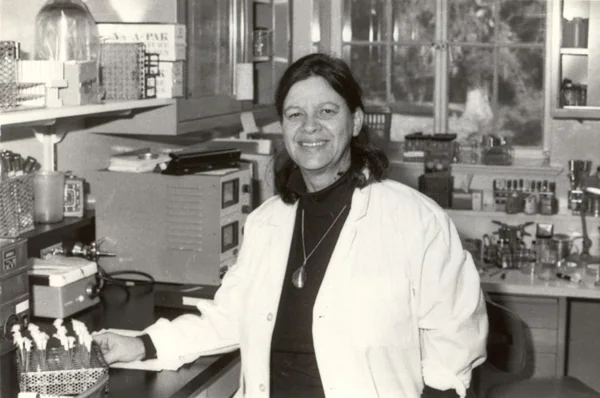
What she actually did
Lederberg made three discoveries that are each foundational. She found lambda phage in 1951 — a virus that integrates into the bacterial chromosome and sits quietly, which became the workhorse of molecular genetics and the model for how viruses hide in host genomes. She discovered the F fertility factor, the plasmid that lets bacteria transfer genes to each other, when a set of crosses inexplicably produced zero recombinants and she reasoned out why. And she devised replica plating: press a velvet pad onto a plate of bacterial colonies, then onto fresh plates, and you can transfer thousands of colonies in their exact spatial arrangement at once. That trick made it possible to screen mutants at scale, and it is how the Lederbergs demonstrated that mutations arise randomly rather than in response to selection.
Why you have never heard of her
She is the clearest case in this collection of credit flowing to a spouse. Joshua Lederberg received the 1958 Nobel Prize in Physiology or Medicine. Esther's work underpinned much of what was cited; she was not included. Replica plating is routinely attributed to him alone, though the technique was hers and the velvet was reportedly her idea. She spent her career in soft-money, non-tenure-track positions. When she was finally made a research associate professor at Stanford in 1974, she had to fight for it, and it was untenured. After their divorce, textbooks largely stopped mentioning her at all.
Her life
She grew up poor in the Bronx during the Depression, lunching on a piece of bread with tomato juice. She took her degree at Hunter College, where she was advised to study French instead of biochemistry, and ignored the advice. At Stanford for her master's she was so short of money that she ate frog legs left over from laboratory dissections.
When she asked Edward Tatum to teach her genetics, he put her off until she worked out why a single fly in a bottle of Drosophila had differently coloured eyes. She solved it, and he made her his teaching assistant. She married Joshua Lederberg in 1946 and followed him to Wisconsin, completing her own doctorate there in 1950.
The 1950s at Wisconsin were her great decade: lambda phage, specialised transduction, the F factor, replica plating. The F factor discovery is a particularly good illustration of how she thought. In her own words: "In the course of such linkage studies, one day, ZERO recombinants were recovered. I explored the notion that there was some sort of 'fertility factor' which if absent, resulted in no recombinants. For short, I named this F."
At Stanford from 1959 she founded and ran the Plasmid Reference Center, the international repository that assigned and catalogued plasmid names — infrastructure the whole field depended on. She loved early music, played the recorder, and co-founded the Mid-Peninsula Recorder Orchestra. She remarried in 1993 and died in 2006.
“One day, ZERO recombinants were recovered. I explored the notion that there was some sort of 'fertility factor' which if absent, resulted in no recombinants. For short, I named this F.”— Esther Lederberg, on discovering the F plasmid
Things worth knowing
- Lambda phage is everywhereIt became the standard model for how viruses integrate into host genomes, a cloning vector, and the system in which gene regulation was first worked out in detail.
- Replica plating is still done exactly her waySterile velvet, a cylindrical block, a stack of agar plates. Undergraduates do it today with the same materials.
- She proved mutations are randomThe replica plating experiments she and Joshua ran showed that resistant mutants exist before the selective agent is applied — not caused by it. It is one of the decisive experiments in evolutionary biology.
- Never tenured, everDespite three foundational discoveries, she held research-track positions her whole career and had to campaign even for an untenured associate professorship in 1974.
- She ran the world's plasmid registryThe Plasmid Reference Center at Stanford, which she founded and directed, was the naming authority for plasmids internationally.
Timeline
Earns a master's at Stanford, eating laboratory frog legs to get by; marries Joshua Lederberg.
Completes her PhD at the University of Wisconsin.
Discovers lambda phage.
Devises replica plating with Joshua Lederberg.
Discovers the E. coli F fertility factor.
Joshua Lederberg receives the Nobel Prize. She is not a recipient.
Becomes an untenured research associate professor at Stanford after a long fight.
Founds and directs the Plasmid Reference Center.
What it means now
Modern molecular biology runs on her tools. Every lab that uses a lambda vector, every experiment that depends on plasmid transfer, every replica plate is working in her debt. Her case asks a hard question of how science assigns credit inside a marriage — and the answer, for most of the twentieth century, was that it did not.
