

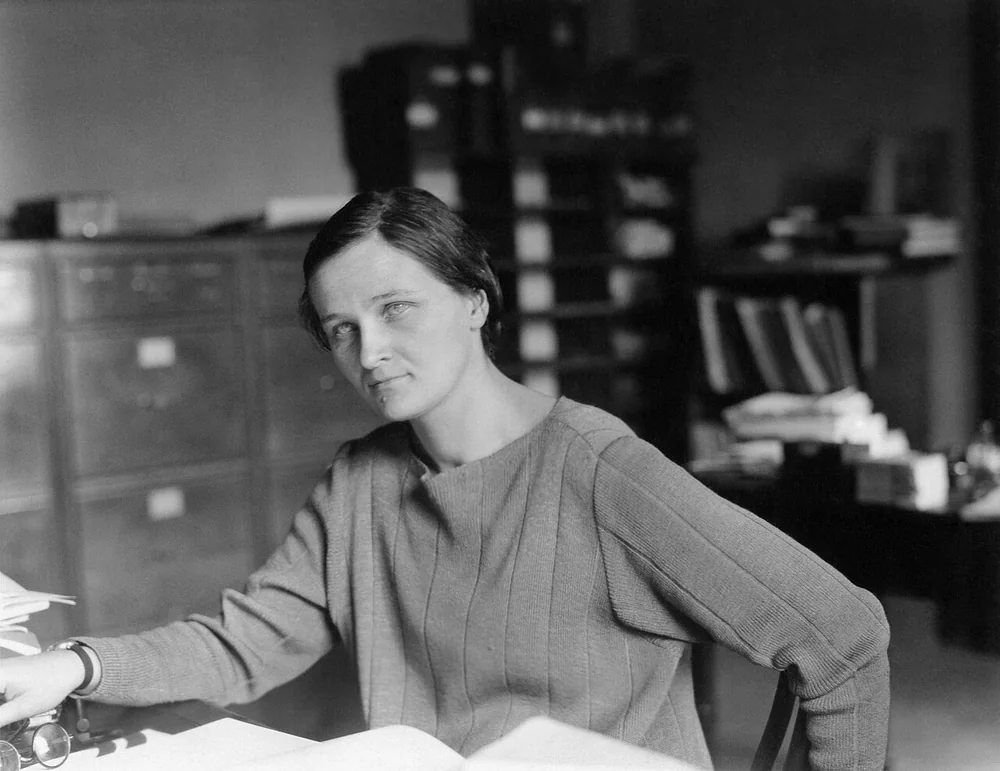
What she actually did
In her 1925 doctoral thesis Stellar Atmospheres, Payne applied the new physics of ionisation to the spectra of stars and reached a conclusion nobody expected: stars are overwhelmingly hydrogen and helium. Everyone had assumed the sun had broadly the same composition as the Earth, with iron and silicon dominating, because those elements showed up strongly in solar spectra. Payne showed the spectral lines reflected temperature and ionisation state, not abundance — and that hydrogen outnumbered everything else by a factor of about a million. She had found what the universe is made of.
Why you have never heard of her
Henry Norris Russell of Princeton, the most powerful astronomer in America, reviewed her thesis and told her the result was "spurious" — it simply could not be true. Payne, twenty-five and without a permanent position, inserted a line stating that her hydrogen and helium abundances were "almost certainly not real". Four years later Russell reached the same conclusion by a different route and published it; the discovery was credited to him for decades. Payne spent years afterwards on low-paid technical work; the courses she taught at Harvard were not even listed in the university catalogue until 1945.
Her life
Payne's career nearly ended before it started, twice. Her school in Paddington offered no mathematics or science. Transferring to St Paul's Girls' School, she was encouraged by her music teacher — Gustav Holst — to become a musician instead. She chose science, won a scholarship to Newnham College, Cambridge, and in 1919 attended Arthur Eddington's lecture on the eclipse expedition that confirmed general relativity. She described the effect flatly: "My world had been so shaken that I experienced something very like a nervous breakdown."
She completed her Cambridge studies and received no degree, because Cambridge did not award degrees to women until 1948. Her only British career option was schoolteaching. So she found a fellowship and sailed for Harvard in 1923.
Two years later she produced the thesis. Harvard did not grant doctorates to women either, so the degree came from Radcliffe — making her the first person of any sex to take a PhD in astronomy from the Harvard observatory. Otto Struve later called it "the most brilliant PhD thesis ever written in astronomy". Modern figures for the Milky Way are about 74% hydrogen and 24% helium, which is what she said in 1925.
She stayed at Harvard her entire career, carried out more than three million observations of variable stars with her assistants, married the astronomer Sergei Gaposchkin, raised three children, and waited. In 1956 she became the first woman promoted to full professor from within Harvard's Faculty of Arts and Sciences, and then the first woman to chair a Harvard department. She was fifty-six.
“The reward of the young scientist is the emotional thrill of being the first person in the history of the world to see something or to understand something.”— Cecilia Payne-Gaposchkin
Things worth knowing
- She wrote the disclaimer herselfUnder pressure from Russell, Payne added to her own thesis that her result was "almost certainly not real". It was the price of being allowed to publish the rest.
- Her teacher wanted her to be a musicianGustav Holst, composer of The Planets, taught her music at St Paul's Girls' School and urged her toward a musical career.
- Cambridge gave her no degreeShe finished the course in 1923. Cambridge did not award degrees to women until 1948, by which time she was running research at Harvard.
- Her courses were invisibleThe classes Payne taught at Harvard did not appear in the university catalogue until 1945 — officially, they did not exist.
- Three million observationsShe and her assistants made more than 1,250,000 observations of variable stars, then added two million more in the Magellanic Clouds.
Timeline
Hears Eddington lecture on the eclipse expedition and switches from botany to astronomy.
Leaves Cambridge without a degree and sails for Harvard on a fellowship for women.
Submits Stellar Atmospheres; concludes stars are mostly hydrogen; adds Russell's disclaimer.
Russell publishes the same conclusion independently and receives the credit.
Given the title "Astronomer" at Harvard — on the explicit assurance that it does not make her a professor.
Her courses appear in the Harvard catalogue for the first time.
First woman promoted to full professor from within Harvard's Faculty of Arts and Sciences, then first woman to head a Harvard department.
Receives the Henry Norris Russell Prize — named for the man who told her she was wrong.
What it means now
In 1976 the American Astronomical Society awarded her the Henry Norris Russell Lectureship, its highest honour, named after the man who had made her disown her own discovery. She had the grace to accept it. Her thesis is still read as a model of how to reason from spectra, and the composition of the universe she described is the one we teach.
