

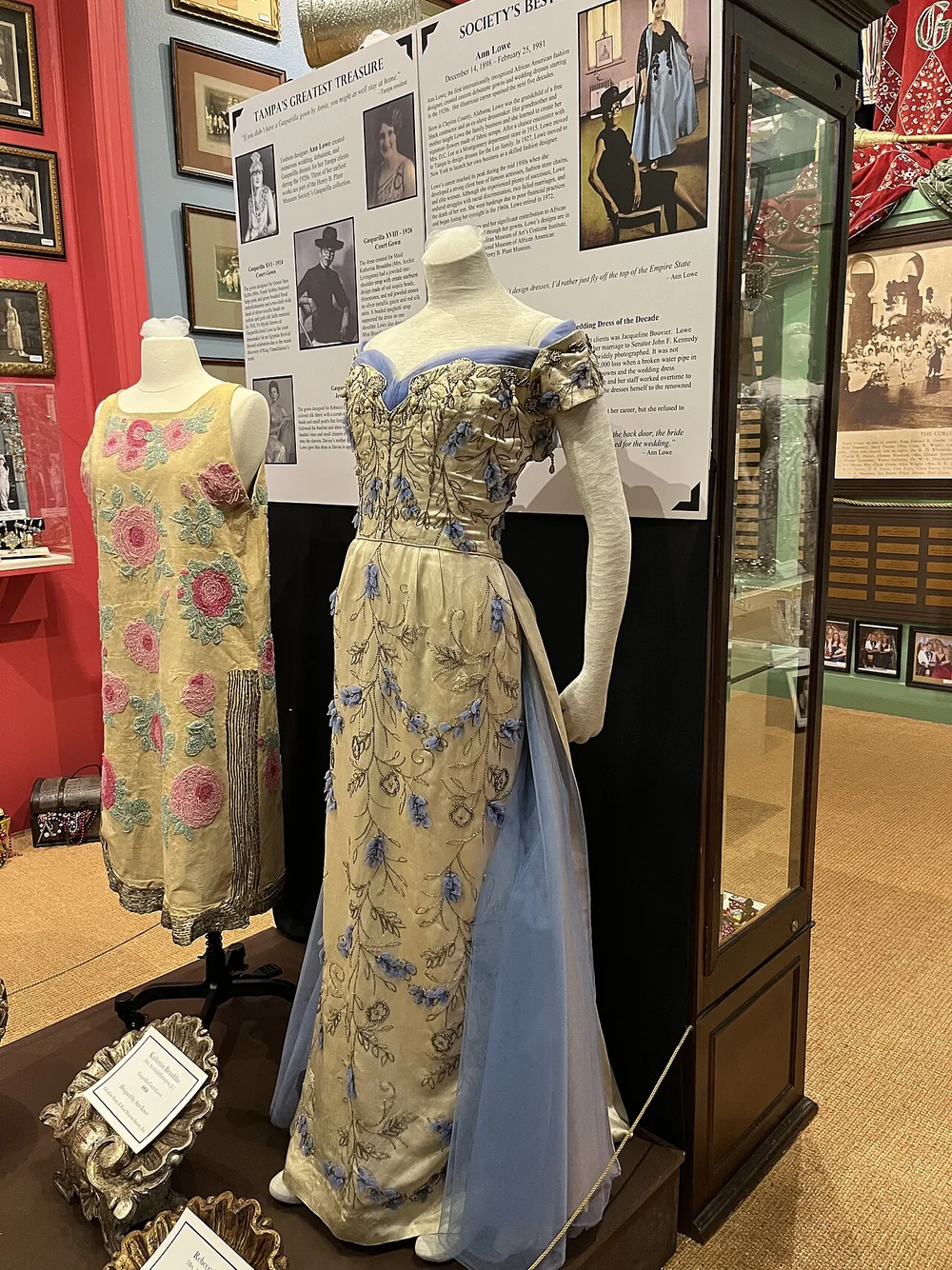
What she actually did
Lowe was a couturier in the full technical sense — she draped, cut and hand-finished one-of-a-kind garments for America's wealthiest families for five decades. Her signatures were trapunto quilting, hand-rolled silk flowers built petal by petal, and construction so precise that conservators still study it. She dressed the Auchinclosses, Rockefellers, Roosevelts, du Ponts, Posts, Whitneys and Biddles. In 1946 she made the gown Olivia de Havilland wore to collect her Academy Award. In 1953 she made Jacqueline Bouvier's ivory silk taffeta wedding dress — fifty yards of fabric, interwoven bands of tucking, circular designs sweeping the skirt — and the bridesmaids' dresses besides.
Why you have never heard of her
The de Havilland Oscar gown went out under the label "Sonia Rosenberg". The Kennedy wedding dress went out under no name at all: Lowe was not publicly credited until after President Kennedy's assassination a decade later. She charged $500 for the most famous dress in America — about $6,000 today — and when a pipe burst in her studio ten days before the wedding and destroyed the gown and ten bridesmaids' dresses, she bought the fabric again, hired extra seamstresses, rebuilt everything, told the family nothing and absorbed the loss herself. On delivery at Hammersmith Farm in Newport she was directed to the service entrance and refused to use it.
Her life
Lowe was the great-granddaughter of an enslaved woman and an Alabama plantation owner. Her mother and grandmother were seamstresses who dressed the first families of Montgomery. When her mother died, sixteen-year-old Ann finished the four gowns left on the table for the governor's wife and took over the business.
In 1917 she moved to New York and enrolled at the S. T. Taylor Design School, which was segregated — she was made to attend classes alone in a separate room. Her work was shown to the white students as an example. She finished the course in half the standard time.
Then came fifty years of high-society commissions in which she was, as the Saturday Evening Post put it in 1964, "society's best kept secret". She opened her own salon precisely because she was not getting credit; her clients regularly talked her down on price; after paying her staff she often made nothing. She was selective to the point of hauteur about it, and said so: "I love my clothes and I'm particular about who wears them. I am not interested in sewing for cafe society or social climbers. I do not cater to Mary and Sue. I sew for the families of the Social Register."
The last two decades were brutal. Her son and business partner was killed in a car accident in 1958. She lost her salon over unpaid taxes in 1962, lost her right eye to glaucoma the same year, and declared bankruptcy in 1963. An anonymous friend paid off her debts — some accounts say it was Jacqueline Kennedy. She opened again on Madison Avenue in 1968 and retired in 1972.
“I love my clothes and I'm particular about who wears them… I sew for the families of the Social Register.”— Ann Lowe
Things worth knowing
- Ten days, one flood, no mention of itA burst pipe destroyed the wedding gown and ten bridesmaids' dresses. She remade all of them, paid for the replacement silk out of her own pocket, and never told the Auchinclosses it had happened.
- $500 for the dress of the centuryRoughly $6,000 today — well below what the work was worth. She estimated she lost about $2,200 on the commission once the flood was accounted for.
- Her Oscar gown carried someone else's labelOlivia de Havilland accepted the 1947 Best Actress award in a Lowe dress sold under the name Sonia Rosenberg.
- She refused the back doorTold to deliver the gowns through the service entrance at Hammersmith Farm, she said that if the dresses were going in, she was going in the front.
- "The Dean of American Designers"Ebony gave her the title in 1966. Christian Dior admired her work. The Met and the Smithsonian now hold her gowns.
Timeline
Aged sixteen, finishes her late mother's commissions for the Alabama governor's wife and takes over the business.
Graduates from S. T. Taylor Design School in New York, having studied in a segregated room.
Returns to New York with $20,000 saved from her Tampa salon.
Designs the gown Olivia de Havilland wears to the Academy Awards — credited to another label.
Makes Jacqueline Bouvier's wedding dress and the bridal party's gowns; receives no public credit.
Named Couturier of the Year.
Declares bankruptcy; an anonymous benefactor clears her debts.
Opens Ann Lowe Originals on Madison Avenue; retires in 1972.
What it means now
The single most reproduced photograph of an American wedding is a photograph of Ann Lowe's work, and for ten years the caption did not know it. Five of her designs are at the Metropolitan Museum's Costume Institute; three are at the Smithsonian's National Museum of African American History and Culture. A major Winterthur retrospective in 2023 finally put her name on the wall at the size the work deserves.
